Chicken Karma

Chicken Karma
Showing posts with label Pearly Gates. Show all posts

Monday, 23 March 2015

Q & A.....
SO, WHERE DO YOU GET YOUR IDEAS FROM?

I reckon this would have to be the most asked question of any cartoonist. I wouldn't mind having a dollar for every time I've been asked that question, and I'm sure other cartoonists would say the same.
Interestingly, it is not just non-cartoonists who ask this question. Even cartoonists are curious about the "inspiration process" of other cartoonists.

A couple of weeks ago I was very privileged to share dinner and several hours with Stephan Pastis, the cartoonist behind the PEARLS BEFORE SWINE comic strip (hugely popular in the US and around the world) and a couple of other cartoonists from Brisbane.
It was a wonderful time....good meal, great conversation, excellent company, lots of laughs.
But one of the high-points for me was hearing Stephan talk about how he gets his ideas for the comic strip. 

It so happens that it is quite different to the process (if it can be called that) that I go through.
But that's the thing with inspiration....it is not a neatly packaged commodity that you can buy on a supermarket shelf. It is quite a personal and individual thing, really.


So.....How do I get my ideas for my cartoons?

Let me answer by telling you a little story......
My cartooning career was officially launched back on September 23rd, 1980, the date I was first published in a newspaper. It was not with BUSHY TALES, nor even PEARLY GATES....it was a very early comic strip I did which was originally called BUNYIP (later changing name to KEG).

Anyway, prior to the date of publication I was interviewed by the paper (the Gold Coast Bulletin) for an accompanying story on the day of publication.
This was my first ever press interview and I thought it went really well. Of course, one of the questions I was asked was "How do you get your ideas for the comic strip?"
Now, as I was very inexperienced at this sort of thing, I answered honestly. I later learnt that was a mistake. But, in my first interview I was just happy to answer any questions the friendly reporter asked and, so, I answered honestly. It went something like this....

HE: How do you get your ideas for the comic strip?
ME: Usually when I'm relaxed. Often I will get ideas whilst I'm in the shower. You know, when I'm relaxed.


Of course, I was very excited about the launch of my cartoon in the paper and, when a copy of the paper was delivered to me I hastily opened it up to see how the interview came across and what the comic looked like in print.

On the front page of the paper it had a little promo for the article inside...."Turn to Page 5 to meet our new cartoonist" (or something like that).
So I turned to page 5.

And almost died.

"Ian strips for strip ideas!"... Was the banner headline that greeted me (and every other reader of that day's edition) on page five!
Looking at it later on I could see that it was a great headline...but at the time I was mortified that my simple, innocent comment about the source of my inspiration could be so twisted!

I was on a steep learning curve in those early years and one thing I learnt very quickly was not to be so honest with friendly reporters!

How do I come up with the ideas now?
Truly, I wish it were a simple formula that could be reproduced on command. But it isn't.
Some cartoonists draw their way (through doodling, character sketches etc) to their idea. I find that doesn't work for me.
Over the years I have discovered that I need to keep my eyes and ears open....maybe it is just a word, or a phrase, that I will hear that will trigger an idea, or a gag.
Maybe it is something I will see.
For me it is really all about trying to be a sponge that absorbs anything that might, at some stage, spark a creative urge. I write these things down in a notebook...sometimes the little notation may sit there for months, like a seed waiting for the rain to nourish it to fruition. Other times, the idea comes together pretty quickly.


And, sometimes, the ideas come from the characters themselves. When you have clearly defined characters and themes in the strip,it is not unusual for ideas to come from there...though you do have to be careful not to be repetitious. 

But you know.... this is a crazy business!...Not only is it difficult to come up with an idea for every day of the year...but the ideas you might think are great may not come across as all that great to others.
This is because humour, like most forms of artistic endeavour, is a very subjective thing.

So, it is not only about coming up with an idea, but trying to come up with an idea that works well, hopefully, for others, too.
It's enough to make you go crazy! 

But maybe you need to be a bit crazy to be a cartoonist, anyway!


DOUG'S INCREDIBLE JOURNEY Continued....
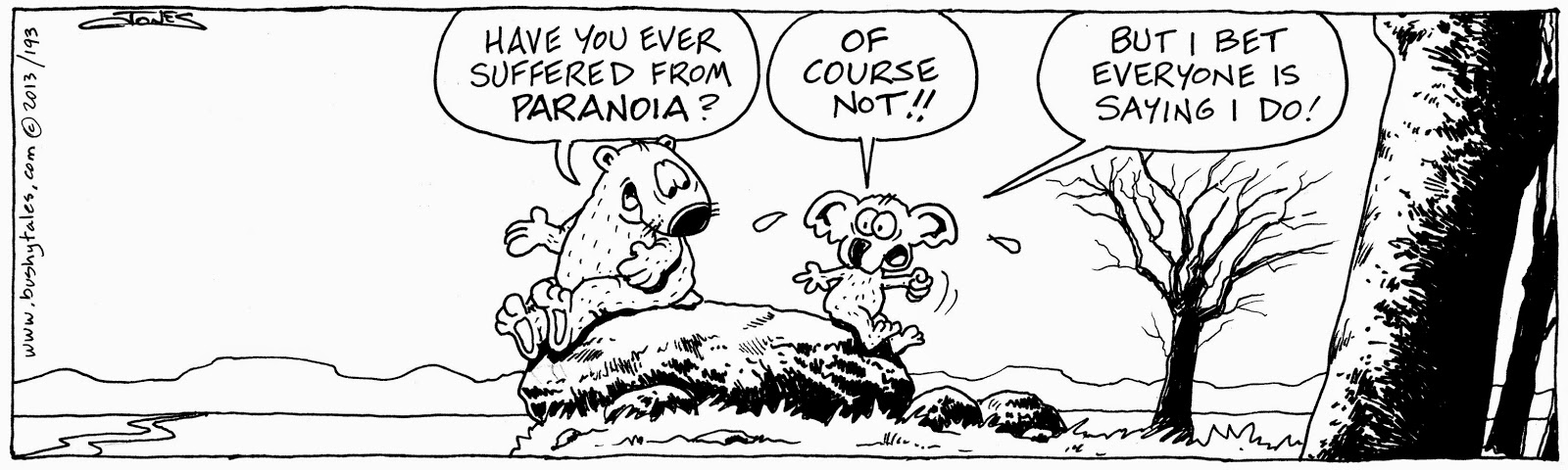
Following on from last week's blog, here are a few more in the series of strips tracing Doug's journey back to his old home. I am really enjoying the opportunity that a change of scenery provides for the strip artistically.




YOUNG READERS ACTIVITY PAGEI am still working on some activities for this page so it will be ready for next Monday's blog.
Stay tuned!

Until next week.
Joyfully yours,

Ian 

WEBSITE: www.bushytales.com
FACEBOOK: www.facebook.com/BushyTalesComicStrip

Monday, 2 March 2015

The Art of "BUSHY TALES"

PRESENTATION

From the very first BUSHY TALES strip, it has always been my desire and commitment to present the strip in a very visually and aesthetically pleasing way. 

For sure, I want the strip to stand out from others because of its high-quality art, but I also want to make the BUSHY TALES strip a joy to look at simply because I love drawing the Australian bush, the setting for the strip and the characters. 
The above image is the title frame from one of the latest BT Sunday strips and it is a good example of how I try to present the strip (I do spend a bit more time on the title frames than other frames where there is action and/or dialogue).

Unfortunately, due to the continually reducing size of comic strips printed in the newspapers, it is a challenge to make a strip "good art" that will not be lost in the reduction, and not just to succumb to using simple line drawings (not that there is anything necessarily wrong with such strips...I just want to do more with BT).
Of course, it never used to be this way......

Back in the days when newspaper comic strips were valued, not just by readers but by editors as well, things were different. The comics were printed at a size that cartoonists can only dream about these days. There was plenty of room for detail and pictorial story-telling. Sadly, as the competition for column space increased, editors took the view that the comics could easily get smaller (and smaller and smaller and.....).

So, as a way of compensating for the increasing reduction in the printed size of their work, cartoonists (with some exceptions) started to use less detail, background and unnecessary "clutter" in their strips. This was/is a great shame.

One cartoonist in recent times who refused to be contained and confined to the restrictions of space was Bill Watterson with his legendary "Calvin and Hobbes" strip. Watterson made his strip a compelling and overwhelmingly effective argument in support of the view that comic strips COULD BE good art. And his art was way better than just good!

Personally, I think many other cartoonists have followed Watterson's lead and influence (I know I have). These days there are many comic strips that are beautifully crafted and drawn, not just relying on the "talking head" approach of former years.
Next week, I will list some of my favourite comic strips (past and present) and many of these strike that delicate balance between the art and the humour with great success.
It is something that I continue to strive for with BUSHY TALES. 

They say that in a comic strip good writing can save bad art, but good art can never save bad writing. So the constant challenge for me (and every cartoonist) is to make sure the balance is in synch and the writing (gag/story) is the priority with the art playing a strong supporting role. It is not always easy, but it is good to have such a criteria to be aiming for....and evaluating with.

PEARLY GATES vs BUSHY TALES

My previous comic strip, PEARLY GATES, and my current strip, BUSHY TALES, are vastly different.
PEARLY GATES was a comic strip based on the age-old gag of St Peter being at the Pearly Gates of heaven. I took the setting and crafted a comic strip that ran continuously every day for almost 20 years. 
However, the strip was somewhat limiting from an artistic point of view.
I used to say (and still do) that PEARLY GATES was not an earthly look at heaven but, rather, a heavenly look at earth. One of the reasons for this distinction was that I had no way of knowing what heaven looks like and, even if I did, it would be way beyond my capacity to draw it, anyway! So I didn't try. My characters spent all their time sitting around on the proverbial clouds.
Sometimes, I would switch to a scene down on earth for a bit of variety (and to give me something other than clouds to draw!). But, as much as I loved doing the PG strip, I did find it a rather limiting experience as far as artistic expression goes.

So, with BUSHY TALES, I was definitely looking for something that would allow me to be more creative and expressive. 


THE PROCESS

These days, many cartoonists use computerized and digital programs to draw their cartoons. I'm not one of them. I guess I am a bit 'old school', but I love the feel of pen on paper.So all the BUSHY TALES strips have been drawn by hand. My hand.

I am always trying to improve my style and, often, I will look back at a strip and think that I could have done it better. I guess that is the ongoing process of development...not just of the cartoon, but also of the cartoonist.

Once I have finished drawing the strip on paper, I then scan the original into the computer and work on the colouring using Photoshop. (It is also in the Photoshop program that I produce a version of the strip in Greyscale.) 

I have always been a big believer in cartooning being a black and white medium (in fact, the Australian Cartoonists Association was originally called the Australian Black and White Artists Club), but I must confess that I do really enjoy colouring the strip....it can take almost as long as the original drawing! 

It is through the colouring that the strip becomes even more of a visual feast and, I hope, a point of attraction and appreciation for readers.
The same strip is shown here in the three different versions....
Black and White
(as it is scanned into the computer), Greyscale and Colour.


 As you can see, there is quite a process in the production of each BUSHY TALES comic strip. I think it is worth the effort....I hope you do, too.


QUESTIONS & ANSWERS (Q&A)

In the coming weeks I would like to do a blog full of answers to  questions from readers.
So...if you have any questions about BUSHY TALES, or cartooning in general, please send them to: bushweekblog@bushytales.com
I'd love to hear from you.

Until next week....

Joyfully yours,
Ian 

WEBSITE: www.bushytales.com
FACEBOOK: www.facebook.com/BushyTalesComicStrip


Purpose

Purpose